
What is a Fluorescent Light Microscope's role in microscopy
Microscopy has undergone significant advancements over the years, providing researchers with powerful tools to observe the microscopic world. Among these tools, the fluorescent light microscope stands out due to its ability to visualize specimens that emit light of a particular wavelength after being excited by a light source. This technique leverages fluorescence, allowing for detailed examination of cellular structures and organic materials that are otherwise challenging to analyze using traditional microscopy techniques.
The fluorescent light microscope has revolutionized biological research and has become an essential instrument in many scientific fields. Its capability to enhance contrast and resolution while allowing for multi-color imaging makes it invaluable for studying complex biological processes at the cellular and molecular levels. With its diverse applications and ongoing technological innovations, the role of fluorescent light microscopy continues to be pivotal in the advancement of scientific knowledge.
Index Content
- Definition of Fluorescent Light Microscope
- Historical Development of Fluorescent Microscopy
- Principle of Fluorescence in Microscopy
- Components of a Fluorescent Light Microscope
- Types of Fluorescent Microscopy Techniques
- Applications in Biological Research
- Advantages Over Traditional Light Microscopy
- Limitations and Challenges in Fluorescent Microscopy
- Future Directions and Innovations in Fluorescent Microscopy
- Conclusion
Definition of Fluorescent Light Microscope
A fluorescent light microscope is an optical microscope that uses fluorescence to generate an image. This type of microscope illuminates the sample with specific wavelengths of light, exciting fluorescent molecules or stains that have been introduced into the specimen. Once excited, these molecules emit light at longer wavelengths, which is then captured to create a detailed image of the sample. This technique is particularly effective for visualizing specific components within cells, such as proteins, nucleic acids, and organelles, enhancing our understanding of their roles and interactions.
Historical Development of Fluorescent Microscopy
The origins of fluorescent light microscopy can be traced back to the early 20th century when scientists first began to explore the properties of fluorescence. The concept was further developed in the 1970s when researchers began utilizing fluorescent dyes and stains to visualize biological samples. The introduction of more advanced light sources, such as lasers, significantly improved the sensitivity and resolution of fluorescent microscopy.
By the 1990s, fluorescent microscopy saw an explosion of innovation, leading to the development of various techniques, including digital imaging and confocal microscopy. This evolution laid the groundwork for modern advancements, such as super-resolution microscopy techniques, which have pushed the boundaries of what can be achieved with a fluorescent light microscope.
Principle of Fluorescence in Microscopy
The principle of fluorescence in microscopy centers on the absorption and emission of light by fluorescent molecules. When a fluorescent light microscope directs light of a specific wavelength onto a specimen, certain molecules absorb this energy and become excited. As these molecules return to their ground state, they release energy in the form of light at a longer wavelength.
This emitted light is what forms the image observed through the microscope. The difference in wavelengths between the absorbed light and the emitted light is known as the Stokes shift, which is crucial for effectively distinguishing between the excitation light and the emitted fluorescence. This principle allows researchers to label and visualize specific structures or molecules within the sample, providing insights into their composition and behavior.
Components of a Fluorescent Light Microscope
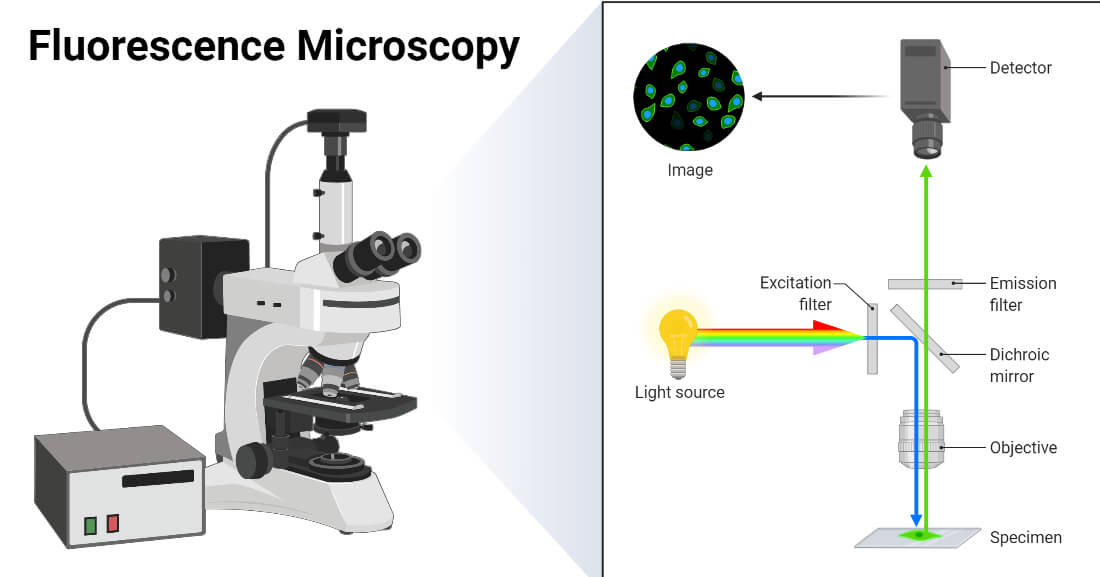
A fluorescent light microscope is composed of several key components that work together to produce high-quality images. These components include:
- Light Source: Typically a mercury or xenon lamp, or lasers, which provide the necessary excitation light.
- Excitation Filter: Selectively allows only the light required to excite the fluorescent molecules to pass through.
- Emission Filter: Filters out any stray excitation light, allowing only the emitted fluorescence to be captured.
- Objective Lenses: Designed to gather light from the specimen and focus it to create a magnified image.
- Detector: Cameras or photomultiplier tubes that capture the emitted light and convert it into a digital image.
Types of Fluorescent Microscopy Techniques
There are several techniques under the umbrella of fluorescent light microscopy, each suited for different types of samples and research questions. Some of the most common techniques include:
- Wide-field Fluorescence Microscopy: The simplest and most commonly used method involving the illumination of the entire specimen.
- Confocal Microscopy: Utilizes a point laser source and a spatial pinhole to exclude out-of-focus light, enhancing resolution and contrast.
- Multi-photon Microscopy: Involves the simultaneous absorption of two or more photons to excite fluorophores, allowing for deeper tissue imaging with reduced phototoxicity.
- Super-resolution Microscopy: Advanced techniques like STED or PALM/STORM that surpass the diffraction limit of light, enabling visualization of structures at the nanometer scale.
Applications in Biological Research
The applications of fluorescent light microscopy in biological research are vast and impactful. Researchers utilize this technique to study cellular structures, investigate protein interactions, and visualize live-cell dynamics. Specific applications include:
- Cell Biology: Understanding cellular processes such as division, signaling, and apoptosis through the use of fluorescent markers.
- Neuroscience: Visualizing neural networks and studying synaptic connections using fluorescently tagged proteins.
- Developmental Biology: Following the development of organisms by visualizing specific gene expressions in embryos.
- Medical Research: Identifying pathogens and diagnosing diseases through fluorescent tagging of specific biomarkers.
Advantages Over Traditional Light Microscopy
The fluorescent light microscope offers several advantages over traditional light microscopy methods. These benefits include:
- Increased Contrast: Fluorescence provides superior contrast compared to unstained samples, allowing for easier identification of structures.
- Specificity: Researchers can target specific molecules or structures within complex samples using fluorescent markers.
- Live-cell Imaging: Many fluorescent techniques allow for the observation of live cells and dynamic processes in real-time.
- Multi-channel Imaging: Simultaneous detection of multiple fluorescent labels enables complex studies involving different targets.
Limitations and Challenges in Fluorescent Microscopy
Despite its numerous advantages, the use of a fluorescent light microscope also presents certain limitations and challenges. Some of these include:
- Photobleaching: Fluorescent dyes can become non-fluorescent over time when exposed to the excitation light, which can limit observation time.
- Phototoxicity: High-intensity light exposure can damage live specimens, affecting their viability during imaging.
- Complexity of Data Analysis: Fluorescent microscopy data often require sophisticated analysis, which can be resource-intensive.
- Cost of Equipment: Advanced fluorescent light microscopes and their maintenance can be expensive, limiting access for some research facilities.
Future Directions and Innovations in Fluorescent Microscopy
The future of fluorescent microscopy holds exciting possibilities with continuous advancements in technology. Innovations such as:
- Development of New Fluorophores: Producing brighter and more stable fluorescent dyes that can withstand photobleaching.
- Improved Imaging Techniques: Enhancements in imaging quality and speed, allowing for better resolution and detail.
- Integration with Other Techniques: Merging fluorescent microscopy with other imaging modalities, such as electron microscopy for comprehensive analysis.
- Artificial Intelligence in Image Analysis: Leveraging AI to automate image analysis and improve the interpretation of complex datasets.
Conclusion
In conclusion, the fluorescent light microscope plays a crucial role in the field of microscopy, opening doors to new areas of research and allowing scientists to explore life at the molecular and cellular levels. With its unique capabilities and ongoing technological advancements, fluorescent microscopy has become an indispensable tool in various disciplines, particularly in biological research. As innovations continue to emerge, we can expect the fluorescent light microscope to evolve further, providing even greater insights into the complexities of life.
Did you find this article helpful? What is a Fluorescent Light Microscope's role in microscopy See more here Education.

Molecules and Light: Understanding Wavelength and Scattering

Facts About Unions: Definition and Historical Insights

Azusa Church: The Historic Revival That Changed Christianity

Cult of Cults: Understanding the Definition and Meaning

Ontario Place: A Journey Through History, Cities, & Facts

What are the traits and lifespan of St. Bernards dogs
Leave a Reply
Related posts