

Molecules and Light: Understanding Wavelength and Scattering
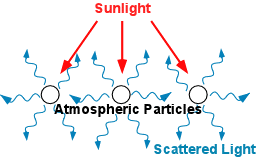
The study of molecules and light encompasses vital concepts essential for understanding numerous natural phenomena. One of the key aspects of this field is the interaction of light with various molecules, which can lead to effects like scattering and changes in wavelength. These interactions not only influence our everyday experiences, such as the color of the sky, but also have profound implications in scientific research and technology.
In this article, we will delve deeper into the principles of wavelength and scattering, particularly focusing on Rayleigh scattering. The insights gained from understanding these concepts are crucial, as they unlock the mysteries of light behavior in our environment and beyond, allowing us to explore not just the skies but also applications across physics, chemistry, and environmental science.
Index Content
- The Nature of Molecules and Light
- Understanding Wavelength: The Key to Light Properties
- What is Scattering?
- Rayleigh Scattering: A Historical Perspective
- How Rayleigh Scattering Works
- The Inverse Relationship Between Wavelength and Scattering
- The Blue Sky Phenomenon: Why the Sky is Blue
- The Role of Atmospheric Molecules in Scattering
- Implications of Rayleigh Scattering in Other Fields
- Conclusion: The Importance of Understanding Light and Scattering
The Nature of Molecules and Light
The interaction between molecules and light is a key area of study in the physical sciences. Light, as a form of electromagnetic radiation, behaves both as a wave and a particle. When light encounters molecules in the atmosphere, it can be scattered, absorbed, or transmitted, fundamentally altering how we perceive our surroundings. This interaction is influenced by the wavelength of the light involved, as different wavelengths interact with molecules in distinct ways.
Understanding these interactions requires a grasp of concepts such as wavelength and the types of scattering that can occur. The size of the particles relative to the wavelength of the incident light plays a significant role in determining the nature and degree of scattering. Smaller particles, typically less than 1/10 the wavelength of the light, will exhibit different scattering behaviors compared to larger particles.
Understanding Wavelength: The Key to Light Properties
Wavelength refers to the distance between successive peaks of a wave. In the context of light, different wavelengths correspond to different colors. The visible spectrum ranges from approximately 400 nanometers (nm) for violet to about 700 nm for red. This range is significant because the molecules present in the atmosphere are typically small compared to these wavelengths, which leads to scattering phenomena like Rayleigh scattering.
The interaction of light with molecules due to its wavelength greatly influences its properties. A notable characteristic of light is that shorter wavelengths (blue light) undergo far more scattering than longer wavelengths (red light). This disparity becomes very apparent when observing why the sky appears blue during the day and red during sunrise and sunset.
What is Scattering?
Scattering is the process by which light is forced to deviate from a straight trajectory, resulting from its interaction with particles or molecules within a medium. This phenomenon does not merely disperse light but also modifies its direction and wavelength, leading to various observable effects. The extent and nature of scattering depend on factors such as the size of the particles, the wavelength of the incident light, and the angle of observation.
There are several types of scattering, including Rayleigh scattering, Mie scattering, and Tyndall scattering. Each of these processes operates under different conditions and produces distinct visual effects. The understanding of scattering is crucial in fields such as meteorology, astronomy, and physics, where accurate predictions of light behavior are essential.
Rayleigh Scattering: A Historical Perspective
Named after the British scientist Lord Rayleigh, who explored the phenomenon in the late 19th century, Rayleigh scattering describes how light interacts with particles that are much smaller than its wavelength. Lord Rayleigh published his significant findings on this process in 1871, establishing the groundwork for understanding how the atmosphere affects light. His work laid the foundation for explaining the color of the sky and the behavior of light in various conditions.
Rayleigh's investigations revealed that the intensity of scattering not only varies with wavelength but also with the angle at which light encounters the molecules. In particular, he demonstrated that the intensity of scattering varies inversely with the fourth power of the wavelength. This principle explains why shorter wavelengths, like blue light, are scattered more efficiently than longer wavelengths like red.
How Rayleigh Scattering Works
Rayleigh scattering occurs when light encounters particles in the atmosphere that are significantly smaller than its wavelength. As light waves hit these particles, they cause the electrons within these molecules to oscillate. This oscillation of electrons subsequently produces new electromagnetic waves, effectively scattering the light in various directions. This scattering process is highly dependent on the wavelength of the light and the size of the particles involved.
The crucial takeaway from Rayleigh's theory is that the intensity of the scattering is more pronounced for shorter wavelengths. This leads to the fascinating phenomenon where the sky appears blue during clear daylight. When we look away from the sun, the blue light that is scattered in various directions becomes the dominant color we perceive, while the longer red and yellow wavelengths are less scattered and thus less conspicuous.
The Inverse Relationship Between Wavelength and Scattering
The relationship between wavelength and scattering is a vital principle in understanding how light behaves in the atmosphere. According to Rayleigh's law, there is an inverse fourth power relationship between wavelength and the intensity of scattering. This means that as the wavelength of light decreases, the intensity of scattering increases significantly.
To illustrate this principle, consider the visible spectrum: blue light, with a wavelength of about 450 nm, is scattered approximately 10 times more than red light, which has a wavelength of about 700 nm. Consequently, this principle explains why we observe a blue sky as blue light is preferentially scattered over the other colors in the spectrum when light from the sun passes through the Earth's atmosphere.
The Blue Sky Phenomenon: Why the Sky is Blue
The characteristic blue hue of a clear sky can be primarily attributed to Rayleigh scattering. When sunlight enters the atmosphere, it collides with air molecules that are smaller than its wavelength. As discussed earlier, the shorter blue wavelengths are scattered more efficiently than the longer red wavelengths. As a result, when we look away from the sun, we see a predominance of blue light in all directions, which gives rise to the blue sky phenomenon.
In addition to daytime scattering, the appearance of the sky also changes during sunrise and sunset. At these times, the sun's light must pass through a thicker layer of the atmosphere to reach our eyes. This increased distance leads to a greater amount of scattering, allowing the longer red and orange wavelengths to dominate the sky's appearance, resulting in the warm colors observed during these times.
The Role of Atmospheric Molecules in Scattering
The composition of our atmosphere plays a significant role in scattering. The major constituents of air, such as nitrogen (N2) and oxygen (O2), are critical for Rayleigh scattering. These gases are approximately one-tenth the wavelength of visible light, making them ideal for scattering interactions. As sunlight passes through the atmosphere, the myriad of tiny gas molecules contributes to the blue appearance of the sky and influences other optical phenomena, like halos and arcs.
Furthermore, larger particles—such as water droplets or dust—can also contribute to scattering but in a different manner (e.g., Mie scattering). The study of how different molecules interact with light provides insight not only into atmospheric optics but also into climate change, air quality, and even cosmic observations.
Implications of Rayleigh Scattering in Other Fields
Understanding Rayleigh scattering is not merely limited to explaining why the sky appears blue; it has far-reaching implications across various fields. In the realm of meteorology, scientists utilize the principles of scattering to improve weather predictions and climate models. By observing changes in scattering patterns, researchers can infer important information about atmospheric conditions, particle concentrations, and even pollution levels.
In astronomy, Rayleigh scattering aids in understanding the light behavior from distant celestial bodies. As light travels through different media, its interaction with particles can shift its spectrum, providing valuable clues about the composition and characteristics of the source. Applications also extend into medical fields where light scattering techniques are invaluable in diagnosing conditions and observing cellular structures.
Conclusion: The Importance of Understanding Light and Scattering
In conclusion, the interplay between molecules and light through processes like Rayleigh scattering not only contributes to our understanding of the visible world but also has critical implications across numerous scientific disciplines. From explaining why the sky is blue to enhancing our knowledge in meteorology, climate science, and astronomy, the study of wavelength and scattering showcases the interconnectedness of various fields of science.
As we continue to explore these phenomena, we deepen our comprehension of the natural world and its complexities, providing a foundation for future innovations and understandings. Recognizing the importance of this knowledge will usher in advancements in environmental science, public health, and technology, proving that the study of light and scattering remains an essential aspect of modern science.
Did you find this article helpful? Molecules and Light: Understanding Wavelength and Scattering See more here Education.

Facts About Unions: Definition and Historical Insights

Azusa Church: The Historic Revival That Changed Christianity
Cult of Cults: Understanding the Definition and Meaning

Ontario Place: A Journey Through History, Cities, & Facts

What are the traits and lifespan of St. Bernards dogs

Bose: Exploring Subhas Chandra Bose's Legacy in the U.S
Leave a Reply
Related posts